



If you’re chronically online (ahem) the new rate of growth among silicon valley startups has likely not escaped you. In the age of AI, $1mn ARR is no longer an exciting feat. Not when your timeline is filled with tweets like this:
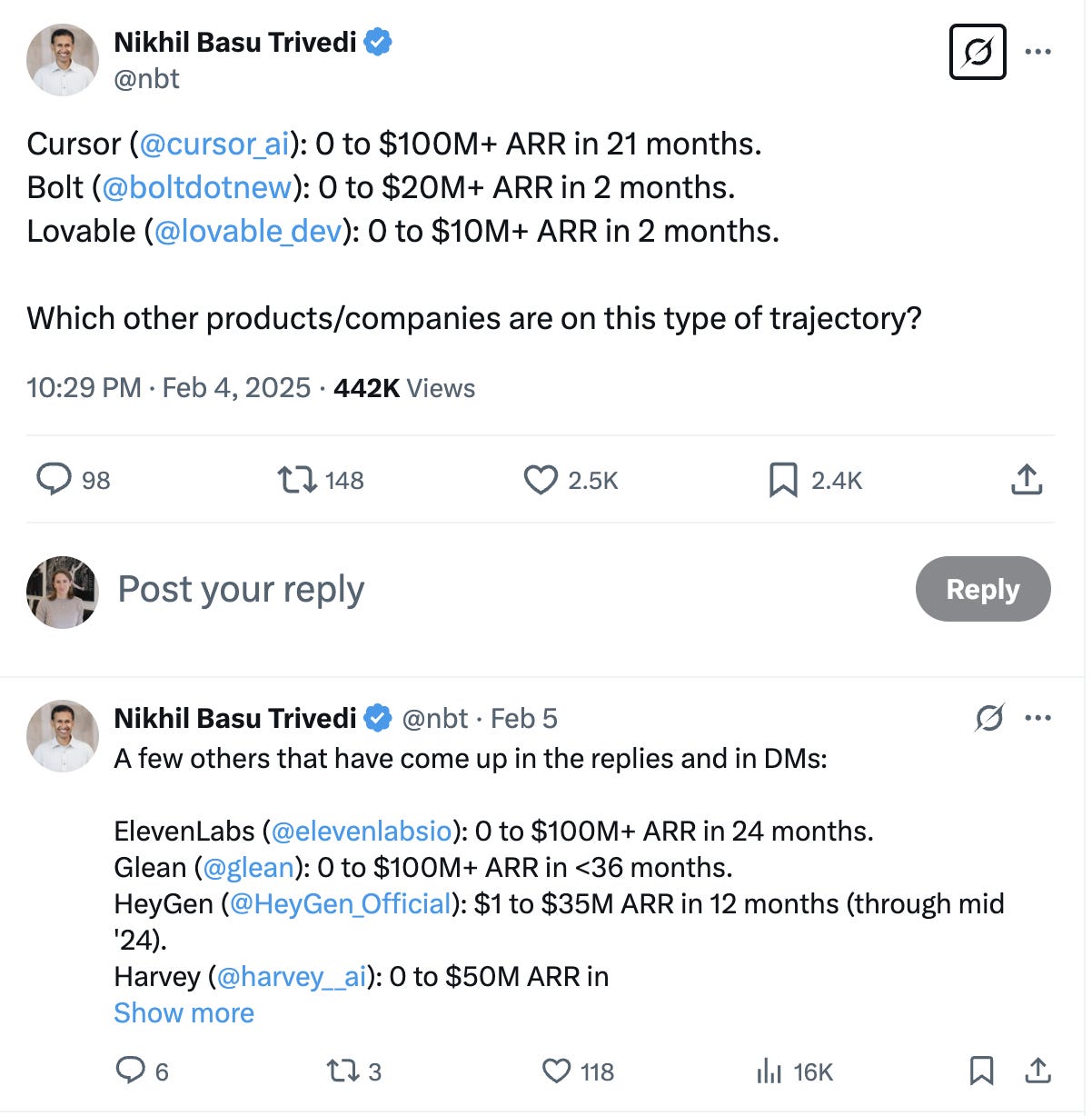
And this isn't just about a few outliers stealing the spotlight (though these companies certainly represent the top 1%). There's a genuinely new growth standard emerging across the AI startup landscape.
Afore Capital recently reported that AI-native companies in their portfolio reached $1M ARR 2x faster and with 5x less capital than non-AI companies
Redpoint Ventures released internal data showing the median growth rate for AI companies at Series B was 2.9x faster (733% for AI companies vs. 254% for non-AI companies)
Stripe noted back in September that their top AI customers took an average of 20 months to scale from $1M to $30M—5x faster than traditional SaaS companies

The remarkable speed at which these AI companies are growing has set off a veritable gold rush among VCs. Long gone are the days when “triple, triple, double, double” was the formula for an oversubscribed round. In this era of AI abundance, tier 1 investors are focusing exclusively on the highest-velocity companies. As one anonymous investor told us: "we're not getting out of bed for less than 5x growth."
It’s clear to everyone that there’s a new generation of blitzscalers hitting the market that appear to be bending the laws of physics.
We’ve entered the age of the AI warpscalers.
What’s driving this phenomena? How are these companies able to grow so quickly and what are the tradeoffs of that hyper-growth? And most importantly — how should these factors change how teams think about their GTM strategy?
Let’s start with the first question first.
The Birth of a Warpscaler: What’s Behind this New Phenomena
This new upper bound on growth potential is driven by two key factors. First, we're witnessing a once-in-a-lifetime market opportunity, where social readiness, technological capability, and purchasing power have perfectly converged.
Second, the fastest-growing AI companies have engineered their products specifically to enable rapid scaling—with design choices that fundamentally remove the traditional barriers to enterprise software adoption.
A Once-in-a-Lifetime Market
We're living through a perfect storm of AI adoption that's the product of three critical market forces:
1. Revolutionary Technology: The "Magic Moment" Effect
At the core of this revolution are AI tools that consistently deliver genuine "magic moments" to users. Tools like Cursor and Bolt dramatically boost engineer productivity and democratize coding, while tools like Harvey and Rogo condense hours of specialized research into minutes of prompting.
The key differentiator is the magnitude of improvement. While traditional SaaS products might offer 10-20% efficiency gains, today's AI tools deliver orders of magnitude more value compared to legacy solutions. In a business world saturated with incremental improvements, these transformative results cut through the noise.
When customers experience real 2-5x improvements in their workflows, word spreads fast, and budget gets unlocked even faster. Being the first to capitalize on magic moments like this is perhaps the most powerful organic growth tactic a company can hope to wield.
2. Executive Mandate: Top-Down Acceleration
The widespread recognition of AI's transformative potential is creating unprecedented executive pressure across industries. Business leaders (and their shareholders) recognize that the next generation of market leaders will be those who leverage AI earlier and more effectively than their competitors.
This executive pressure is adding a top-down mandate to already explosive bottom-up demand. Last year, over 40% of S&P 500 companies mentioned AI on earnings calls—a figure we expect to grow dramatically in Q1 2025. This level of C-suite attention creates two massive advantages for AI startups:
It unlocks dedicated budget specifically for AI initiatives
It reduces or removes barriers to implementation
Some of this is no doubt over-exuberant, as executives initially rushed to purchase leading AI tools based on impressive demos and out of fear of being left behind. It’s possible this tailwind slows down or even momentarily reverses in some sectors over the coming months, as the novelty of these tools wares off, the reality of using them effectively sets in, and the landscape of potential tools becomes increasingly fragmented. But to date it’s been a powerful tailwind that will likely continue in some form or another over the long-term.
3. Capital Concentration: The VC King-Making Machine
The final accelerant? Venture capital's king-making machine has shifted into overdrive.
There's a palpable sense among investors that category-defining AI companies are being built right now. This has triggered an unprecedented race to anoint winners through massive funding rounds designed to help select players suck the air out of a category and establish a dominant market position before competitors can respond.
When we combine transformative technology, executive mandate, and unprecedented access to capital, we get an environment that’s primed to ignite.
Products Built to Scale
While we're definitely living in a unique moment, market conditions alone do not get you products that 100x. If the market dynamics we discussed above are the dry kindling, then a product built for warp speed is the spark.
In addition to riding the macro wave, the fastest-growing AI companies share 4 specific product characteristics that enable their hyper-growth:
1. Lightweight Implementation
Most AI products that scale rapidly require extremely limited setup or integration, or at least offer a lightweight version of the product that doesn’t need to integrate into your stack to show value. They work seamlessly with existing systems and workflows with limited IT involvement or complex configuration.
Why it matters: When users can get immediate value without weeks of implementation, adoption skyrockets. This eliminates the traditional enterprise sales bottleneck and enables product-led growth even for high-ACV products.
2. Immediate, Measurable ROI
The fastest-growing AI products deliver value that's impossible to miss or debate. The calculation is simple: "For every $X you spend, you get $Y back" (where Y > X).
Why it matters: When ROI is obvious (like this "replaces three FTEs" or "generates 10x more leads"), purchase decisions become no-brainers. Entry-level free-tiers and usage-based pricing further reduces buyer friction.
3. Low-Risk Entry Points
Successful AI products offer a "safe" starting point that minimizes perceived risk while still delivering the "wow" factor.
Why it matters: Organizations are wary of AI failures. By starting with contained use cases that don't threaten core operations, products can build trust before expanding to more mission-critical applications
4. Intuitive User Experience
The best AI products guide users with interfaces that anyone can use without training or specialized knowledge, while alleviating the feeling that the AI is a “black box.”
Why it matters: AI can be unpredictable and confusing. Products that feel natural and reliable drive faster adoption, as users don't need to become prompt engineers or AI experts to experience the value.
Not all warpscalers will have all of these characteristics, but some combination of them are structurally necessary to deliver these kinds of growth rates.
The Warpscaler Tradeoff: Low Revenue Quality and the Illusion of PMF
The problem with warpscalers is that at some level, they are trading revenue quality for revenue growth.
This trade-off is inherent to the warp speed model: the very factors enabling rapid customer acquisition—low implementation barriers, minimal integration requirements, bottom-up adoption, and non-mission-critical use cases—are precisely what makes it easier for customers to churn off.
This dynamic is exacerbated by two additional factors:
initial lower friction to adoption also means lower purchasing intent
many early customers fund these tools from experimental budgets vs. core spend
The result? Churn rates that can dramatically outpace industry standards.
What makes this particularly dangerous is the illusion of strong product-market-fit created by this initial customer pull. Teams see hockey-stick revenue and assume they've cracked the code for long-term growth, when they've really got a product with high short-term demand and an unusually low barrier to adoption.
This stands in stark contrast to traditional SaaS, where reaching $1-5M in ARR almost guarantees some degree of PMF, because getting there required winning the hard-fought battles of procurement processes and complex integrations that come with high willingness to pay and create natural stickiness/retention.
A dangerous side effect of this is that it often tricks teams into prioritizing growth at the expense of GTM infrastructure and customer success. The logic feels compelling in the moment: "Why slow down for customer success when you can barely keep up with new demand?"
But as competitors inevitably catch up and technology gets commoditized (which happens with alarming speed in the AI space) your GTM strategy and your relationship with your customers quickly become your most meaningful competitive advantages, especially as knowledge of your customer is what will eventually allow you to build a deeper and more mission critical product.
Many warpscalers realize this lesson too late, and are caught flat footed when growth slows. The best GTM leaders get out ahead of it, knowing that the work that made them an overnight success is not the same work that will make them an enduring company.
The Warpscaler Playbook: Turning Flash Growth into Lasting Value
The art of warpscaling comes in knowing how to balance dizzying growth with investment in the infrastructure needed maintain your distribution gains. So how do you play offense and turn a flash-in-the-pan moment into an enduring advantage?
1. Maximize Your Warpscale Advantages
Double down on what makes AI products uniquely positioned to grow fast:
Accelerate the "aha" moment: The magic moment is your killer advantage, so optimize your entire funnel to deliver that experience upfront. Let users experience value before signup, embed interactive demos, and offer pre-built templates that generate immediate results.
Create a seamless UX: Guide users to value with an intuitive, frictionless experience that’s resilient to user errors and inconsistent inputs. Often this means obfuscating away prompt engineering and making inputs and outputs modular and manipulatable.
Engineer viral loops: Novelty incentivizes sharing and you want to max out on distribution before the “magic effect” of your product dulls or a competitor gets there first. Build sharing mechanisms directly into your product's core workflows, create natural incentives for users to invite others, and tap into “1 to many” distribution channels.
Establish category leadership: The best companies wrangle the new appetite for AI in their industry by making themselves the easy pick. Pursue flagship customers, create high-profile case studies, and maximize PR visibility. Be the “you don’t get fired for buying IBM” of AI tools in your category.
Align monetization with value delivery: Design pricing that scales with the value users receive. The best AI companies make payment feel like a natural extension of receiving value, not a separate decision.
2. Invest in GTM Infrastructure Before You Need It
When users are pulling your product out of your hands, it can be hard to take a step back and spend time investing in process and tooling. However, building GTM infrastructure upfront can unlock growth in the short-term and will help you defend and grow your market share over the long-term.
Build a scalable onboarding process: Proper onboarding is one of the biggest levers to maximize LTV and prevent churn. At warp speed it also quickly becomes the primary bottleneck to growth. Ignore it, and you'll eventually hit a wall where manual processes buckle and growth grinds to a halt. Avoid this fate by investing upfront in streamlining and automating your onboarding process (think AI-driven setup flows, auto-import functionality, seamless authentication) and finding ways to measure and optimize your onboarding funnel. Get this right, and you'll build a system that simultaneously unblocks growth and sets the foundation for lasting retention and customer success.
Build a sales engine: Don’t wait for organic growth to slow to figure out how to actually sell your product. Segment out your customers and experiment with GTM strategies for each so that you can identify scalable, repeatable growth vectors beyond organic discovery. Invest in data infrastructure and a CRM/system of record so you can optimize your funnel and hone in on emerging friction points. The goal is to be able to seamlessly bridge the gap between short-term organic “pull” and long-term sustainable sales engine “push” without missing a beat.
Invest in customer success: Customer success isn't just about retention — your relationship with and knowledge of your customer is your primary competitive moat as AI technology commoditizes. Document customer insights religiously and go deep with customer use cases and workflows. Invest in intelligence systems to track usage and better understand friction points and expansion opportunities. Investing in customer success ahead of time will not only allow you to catch and correct potential issues before they become a more serious problem, it’s also where you’ll gain the insight necessary to build a deeper product. When growth inevitably slows, the companies with the deepest customer understanding will have already built their next wave of differentiated features, while competitors scramble to understand why customers are churning.
3. Create Stickiness and Compound Value
Assume your core technology will be commoditized and build with short and long-term defensibility in mind:
Focus on your best customers first: Prioritize improvements that solve your best customers’ biggest pain points first, rather than chasing every new user request. This ensures you deepen value for your most engaged users (improving net retention) instead of accruing “leaky bucket” customers who churn quickly when their more fringe needs aren’t met.
Target obvious value-additive features first: While you’ll certainly be executing against a long-term product roadmap, make sure to prioritize low-hanging fruit features first to immediately add value and head off potential churn. Add in obvious features that allow your product to embed more deeply or be more accessible within core workflows, or to improve UX. Think native integrations, custom templates, and process automation. The idea is to quickly increase the value your ICP gets from your product while raising the bar for horizontal players or new entrants to compete.
Expand strategically along the value chain: From there identify adjacent problems your customers face and methodically extend your product to address them. Give special attention to functionality that is mission-critical or would be difficult to unwind (think replacing whole work products or reducing headcount) or that allow you to further compound proprietary advantages (e.g. unique data you've accumulated or have access to, domain-specific models, real estate in the user’s existing workflow, unified product experience). Ensure that value compounds in your product over time, keeping customers tied to your platform for superior results that are harder and harder to replicate.
Evolve pricing to lock In value: As you go, test pricing models to find optimal alignment between customer value received and revenue captured. Over time you should aim to transform low-commitment early adopters into more predictable, locked-in revenue.
The most defensible AI companies don't just build better models—they create ecosystems that generate compounding value for users the longer they (and others) stay on the platform. Building this type of a product requires deep customer intimacy to know where and how to systematically expand your platform's value, as well as dedicated organizational bandwidth to execute on those insights.
The Stakes Are Generational
These investments may feel premature when customers are banging down your door. But this moment of extraordinary demand, while a once-in-a-lifetime opportunity, is ultimately fleeting.
The warpscalers who convert this temporary advantage into sustainable growth will have a lasting competitive edge. Those who merely ride the wave will find themselves vulnerable when the initial magic inevitably fades.
The difference isn't just in execution quality - building for enduring value creation while managing explosive short-term growth requires discipline, vision, and the courage to invest ahead of immediate needs.
The warpscalers who master this balance will be able to transform flash-in-the-pan growth into a lasting flame, and in doing so will likely build the next generation of category-defining companies.